First steps: signing up
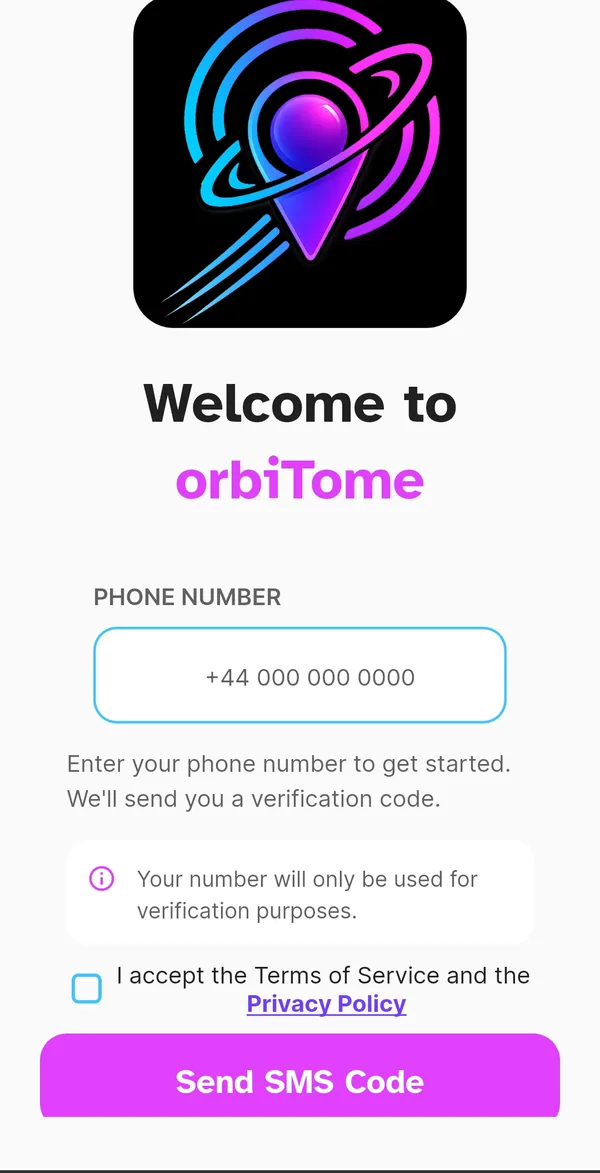
All it takes to start is your phone number: no password to remember, no endless forms. Your number isn't shown to other users — it only opens your account and lets friends who already have you in their contacts find you.
One detail that makes all the difference: orbiTome works across several countries, so the number must be entered with its international dialling code — +44 for the UK, +1 for the US. It is the most common mistake on first sign-in: without the code, the SMS never leaves.
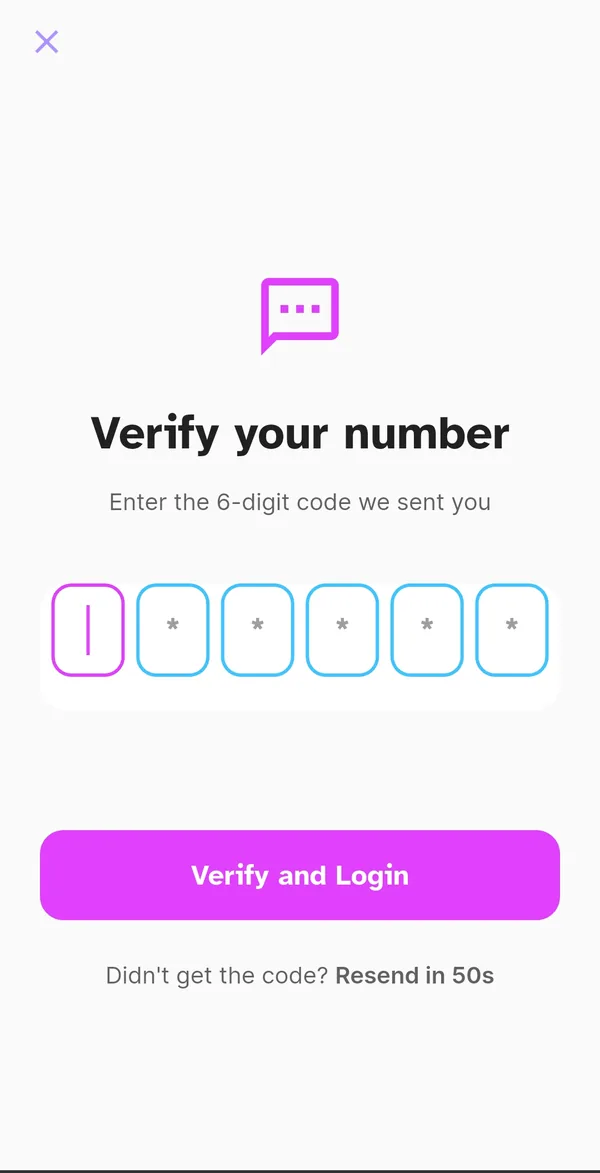
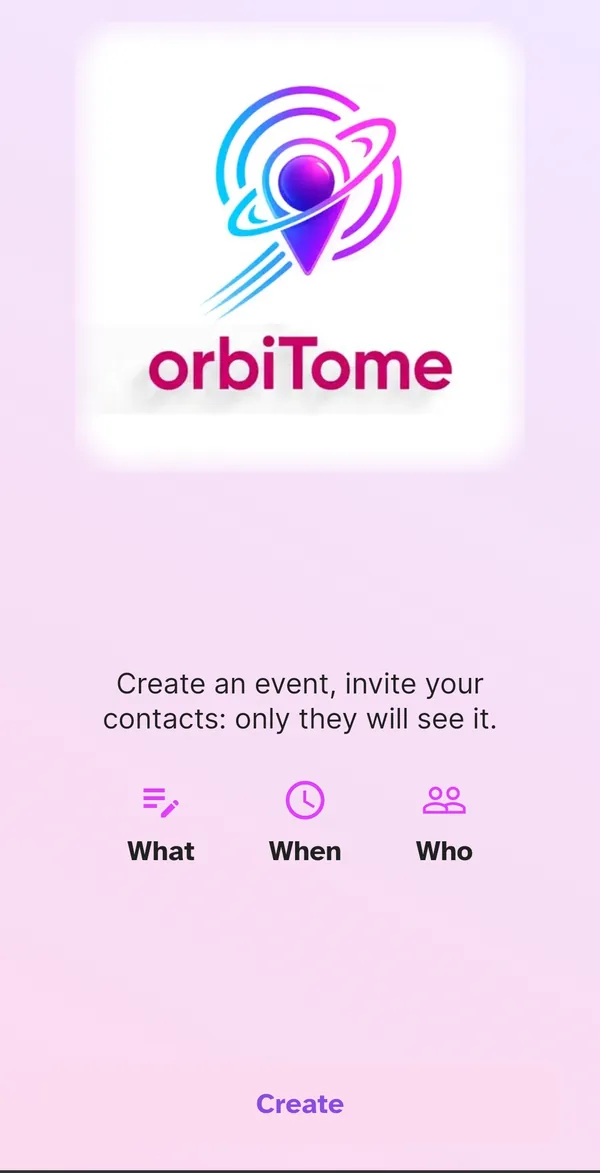
Accept the Terms, tap “Send SMS code” and type in the six digits you receive. If this is your first time opening the app, a single screen sums it up in three words — What, When, Who — and takes you straight to creating your first event. There is nothing to read: the first event is the introduction. You can replay it any time from Profile, under Introduction.
Find your friends
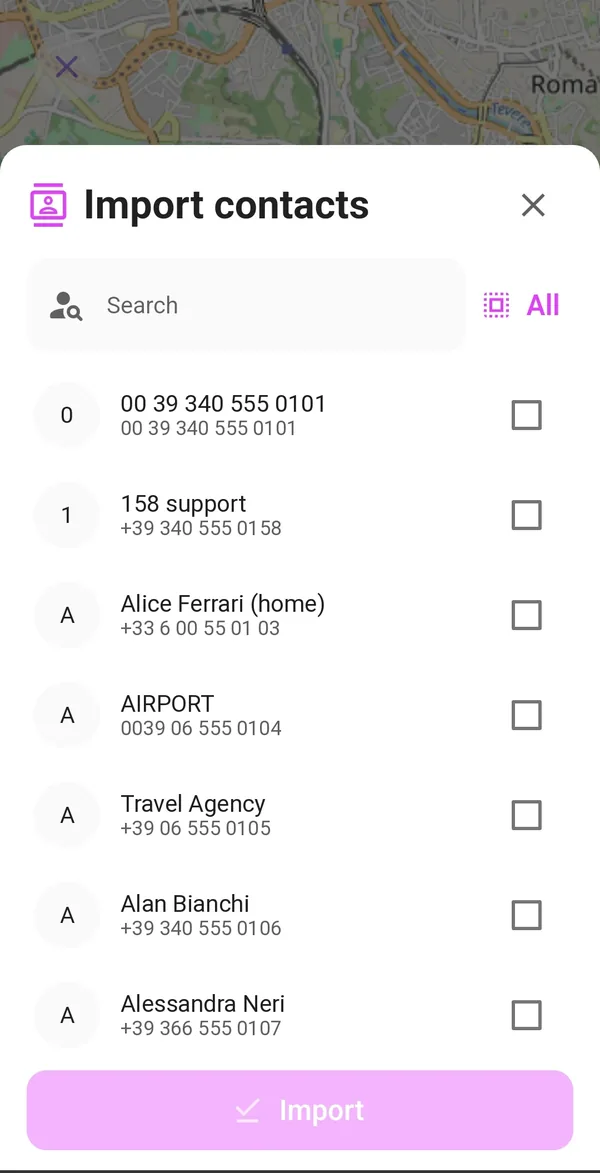
On first launch orbiTome offers to import your contacts, so you can see who is already on board. You decide who to pick: one by one, or everyone at once with “All” — and “None” clears the selection. A progress count runs while the import goes on. The same goes for every import screen in the app — the choice stays yours.
The point we won't compromise on: your address book stays on your phone. Contacts are imported purely to make the app work locally and are not uploaded to our servers.
Home: your map
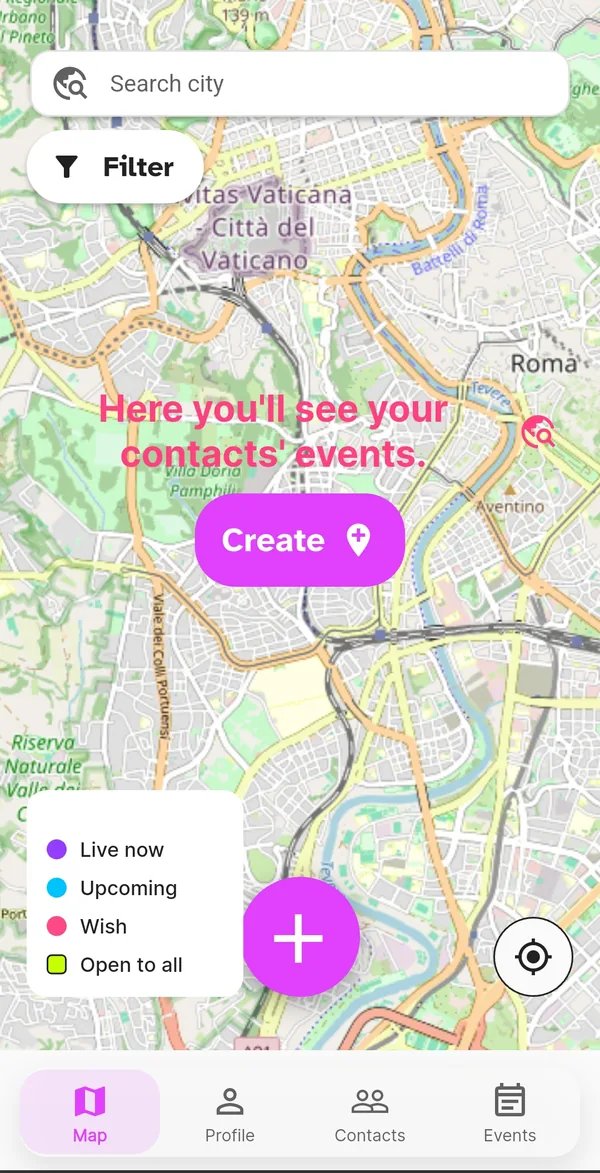
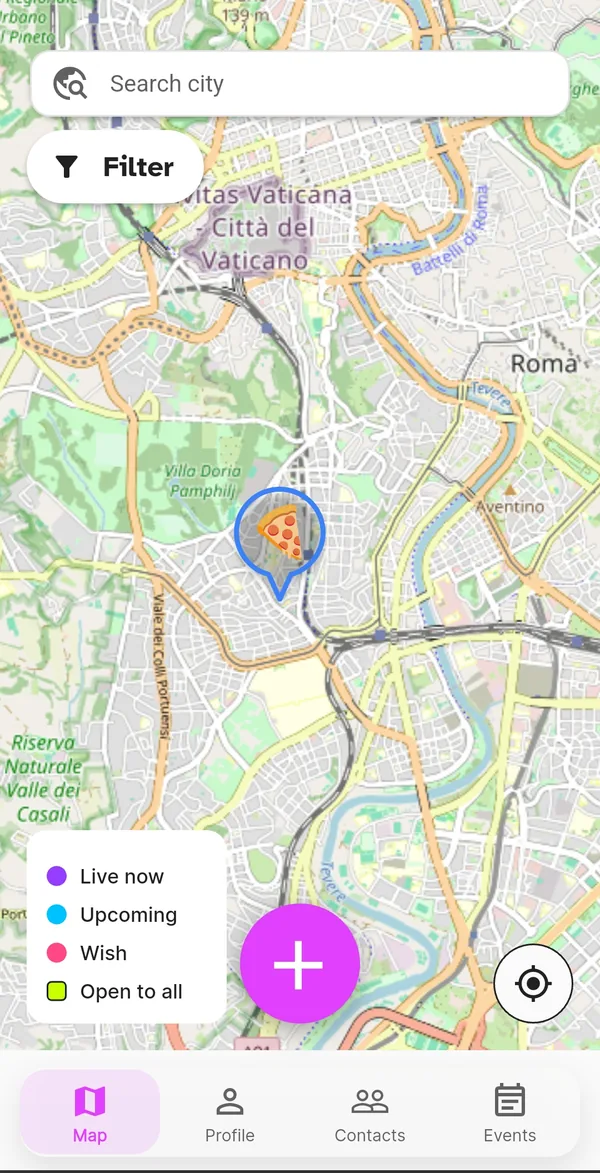
Home is a living map. A small colour key tells you at a glance what each pin means: purple for events happening now, blue for scheduled ones, pink for Wishes — ideas floated by someone looking for company. Alongside your contacts' events, the map can also show public events from cities and associations, published by the orbiTome team.
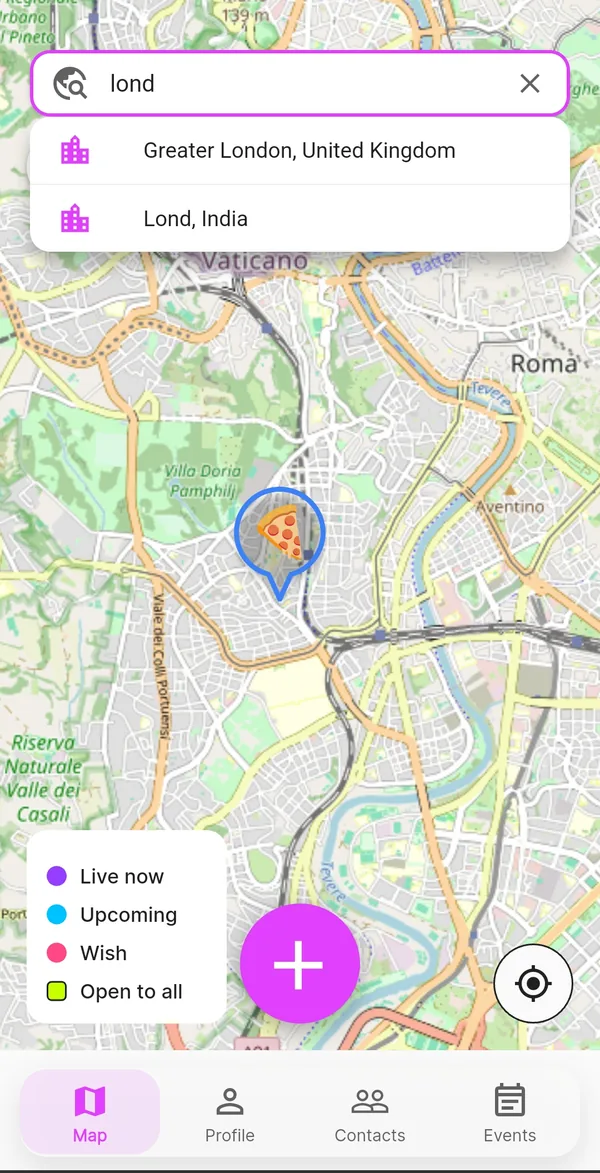
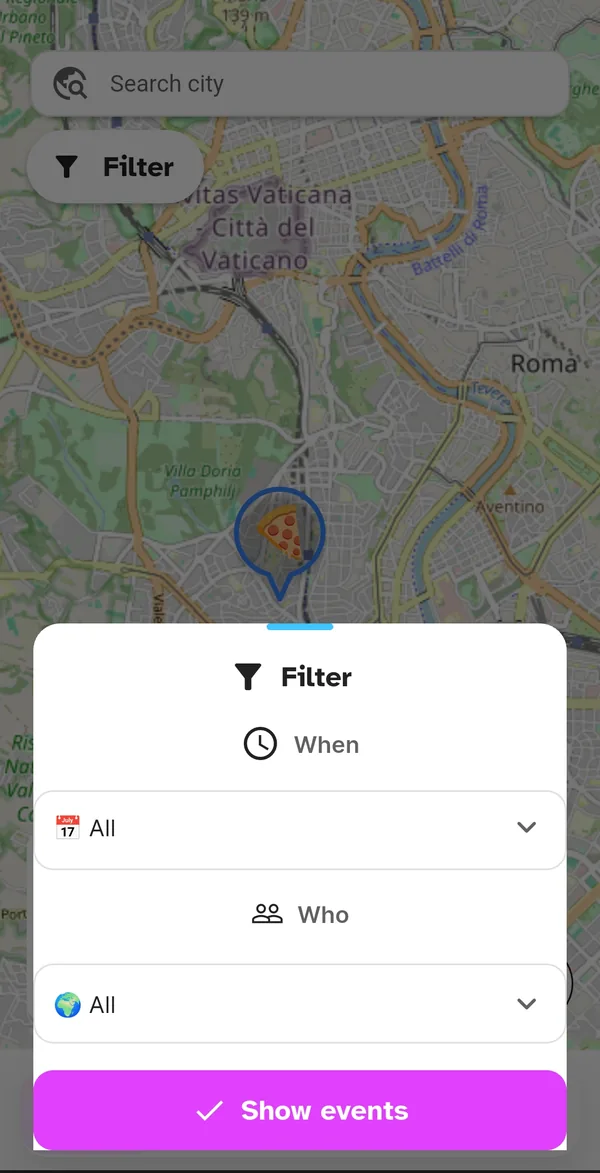
At the top centre there's city search: handy for peeking at what your friends are up to abroad without leaving the sofa. Top left, the Filter button opens a panel where you choose the time window and who you want to see, then you confirm with “Show events”. Bottom right, the button that snaps you back to your own location.
The bar along the bottom links the four main pages — Map (which is also Home), Profile, Contacts and Events — and in the middle sits the + button, where all your events begin.
🏛️ Public events from cities and associations
Alongside your contacts' events, the map can show public events: initiatives from cities, neighbourhoods and associations, published by the orbiTome team after a check.
You can tell them apart because they don't come from someone in your address book: they are visible to anyone using the app nearby, even to people who don't know the organiser. You open one, read the details and decide whether to go, exactly as with any other event.
How many you find depends on where you are: coverage grows city by city.
Create an event in three steps
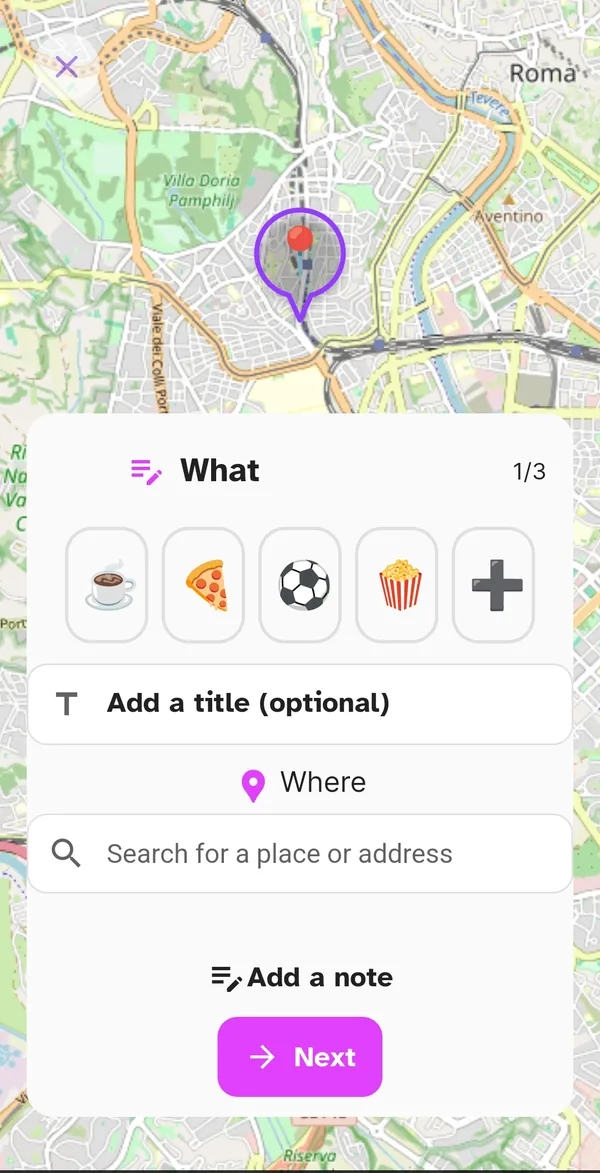
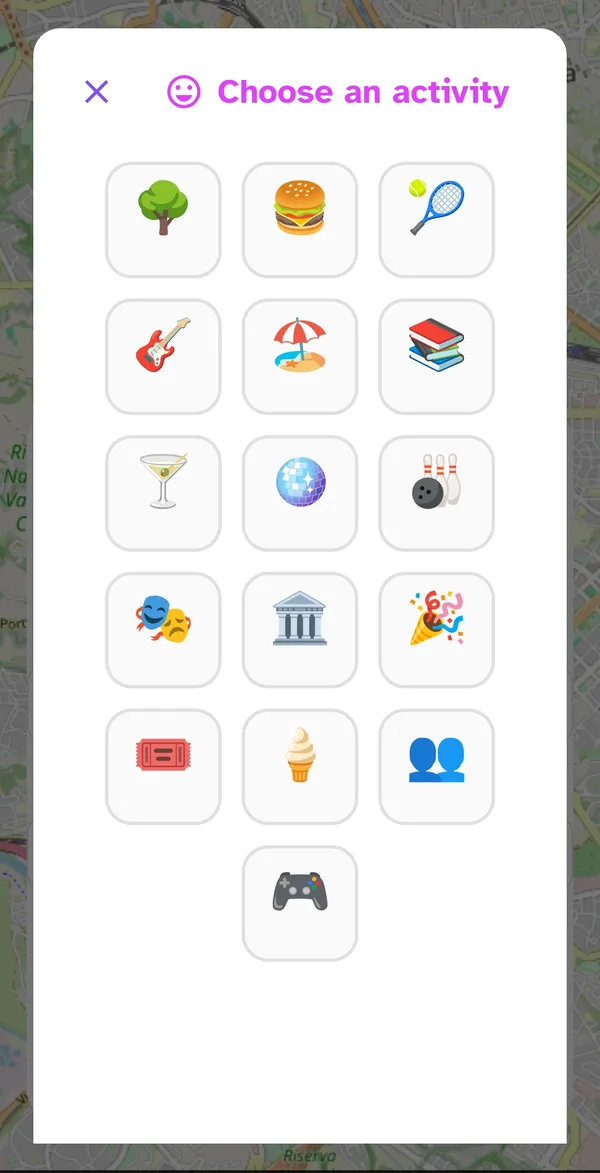
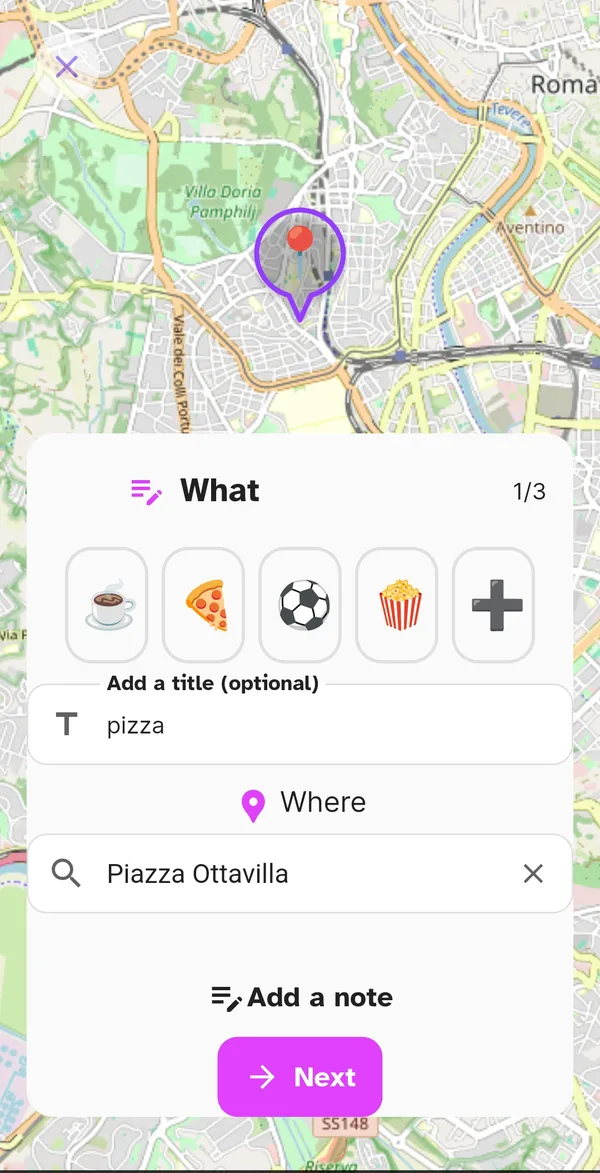
Tap + and follow the three steps: what we're doing, when, and who. In the first one you add a title if you feel like it (it's optional) and pick an activity from the icons — coffee, pizza, sport, cinema and plenty more.
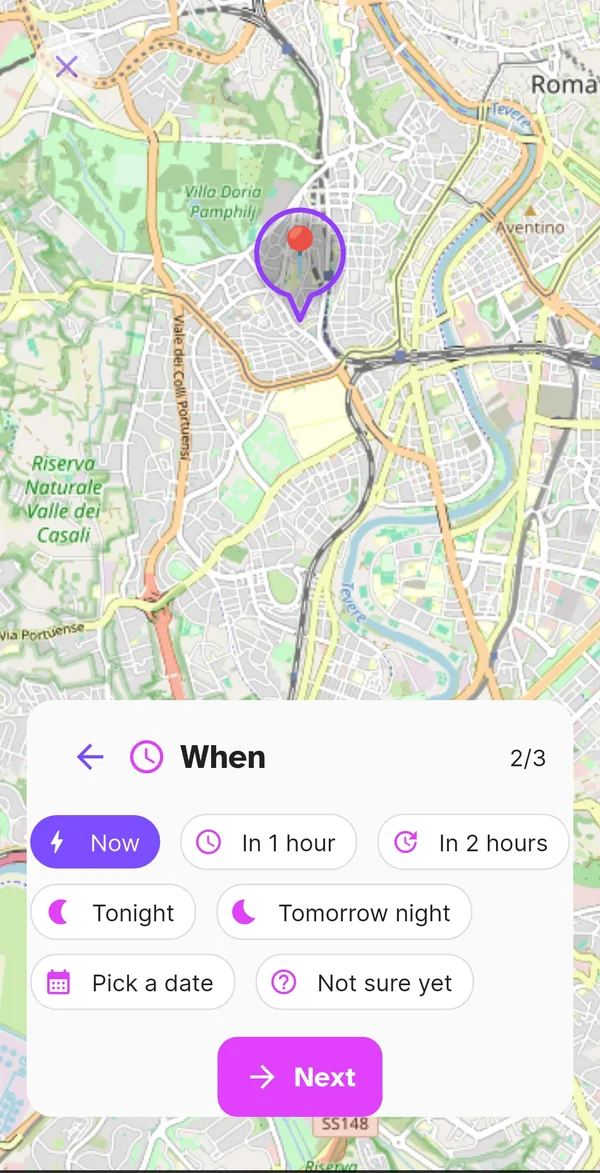
The second step is when: the quick chips for something immediate, Tonight for the evening, or the clock and the calendar for an exact date. The Wish toggle sits in the same flow and changes what the event is: from “I'm organising it” to “I'd love someone to”.
⏳ How long an event lasts
orbiTome events are built to be short-lived: they appear, they happen, they vanish.
The event disappears from the cloud shortly after it ends: how long it stays visible depends on how you created it — the quick chips keep it short, Tonight carries it to the end of the day, a date and time from the calendar gives it a wider window. A Wish expires at the time it names. Your history stays on your phone.
If you created the event and you are there, the app notices and pushes the expiry back an hour at a time, up to six hours from the start: the party doesn't end on your phone while it is still going. If you walk away, the event closes itself shortly after.
💫 Wish: float an idea
Not everything has to be settled in advance. The “Wish” toggle lets you float a want — “I could murder a pizza” — without committing to anything: friends see it on the map and, if they like the idea, they answer.
A Wish is a proposal with no organising behind it: it fixes no place and sends no invitations. Once enough people are in, the “Create” button on its own card turns the wish into a real event: place, time, guests. That button shows only on the Wish you floated yourself — you decide whether it becomes an event. It's the lightest way to find out who's up for it, without organising something that then falls through.
Invite and share
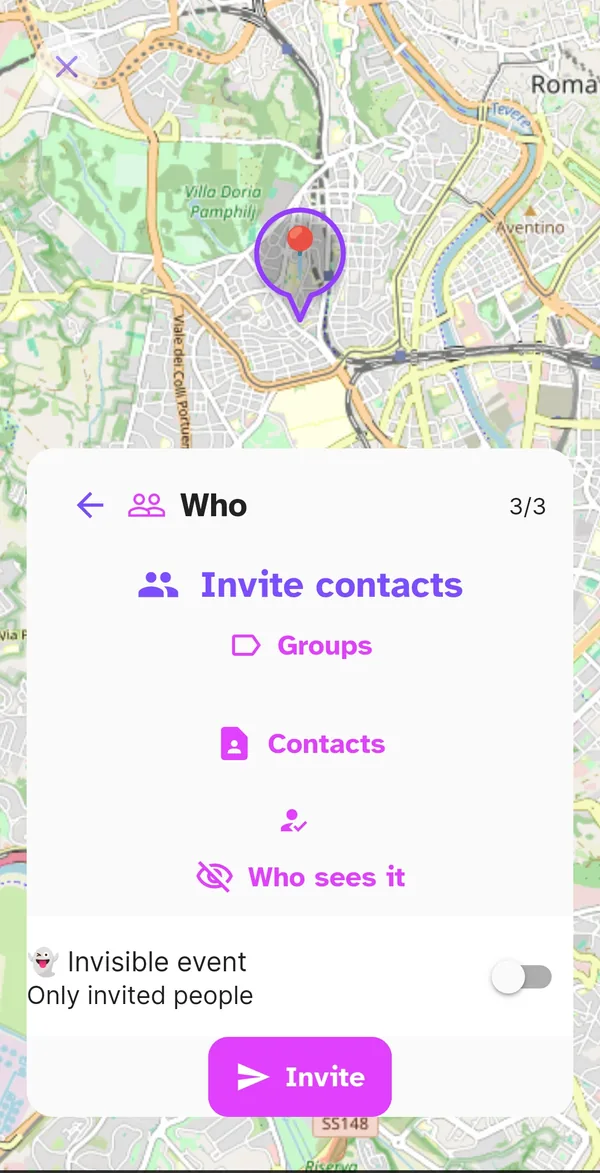
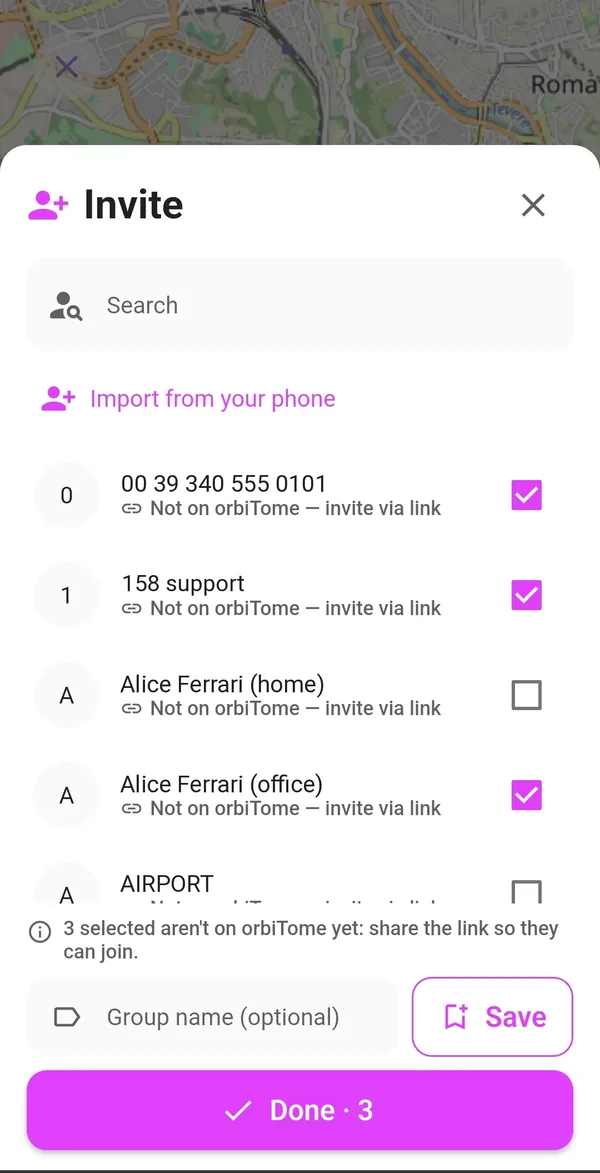
In the third step — Who — you pick who to invite: one by one from Contacts, or by groups. The description and the Where belong to the first step; extra details can be added later from the event card.
Invitations go out one by one or by group, and you can build the group right there: pick the people, give it a name, and it's waiting for you next time.
Then decide whether the event is for invitees only (Invisible event) or open to your contacts who use orbiTome, and tap “Share event”. The moment it's shared, the event appears on the map with its icon and your contacts in the area can see it. Public events from cities and associations, published by the orbiTome team, work differently: anyone using the app nearby can see those.
🔗 The invitation link: one tap and you're in
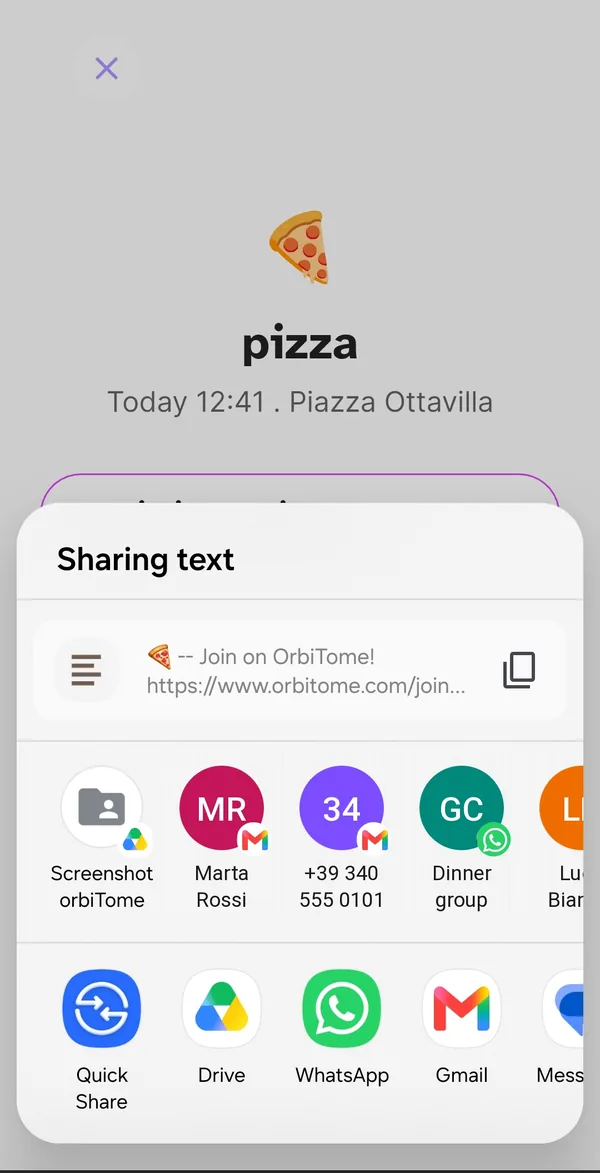
When you share an event, orbiTome mints a dedicated web address — something like orbitome.com/join/… — that you can send wherever you like: messages, email, your social apps, even printed as a QR code. The app shows you the messaging apps already on your phone and you pick one.
The interesting part is what happens at the other end. If they already have orbiTome, the link skips the browser and opens the event straight inside the app, ready to join.
If they don't, they aren't forced to install anything: a web page opens with all the event details — what, where, when, who's proposing it — along with a link to the right store, App Store on iPhone and Google Play on Android. Anyone who installs at that moment finds the invitation waiting for them.
👻 Invisible event: invitees only
Some events are for a select few. When it is invisible, the event shows up only for the people you invited: for everyone else it simply doesn't exist. The screen spells it out, with a counter of how many people can see it.
Note what it applies to: invisibility acts on the event, not on you. It does not make you invisible and it does not depend on tags or groups: it only settles that this event is seen by the people you invited.
Contacts: your address book, managed by you
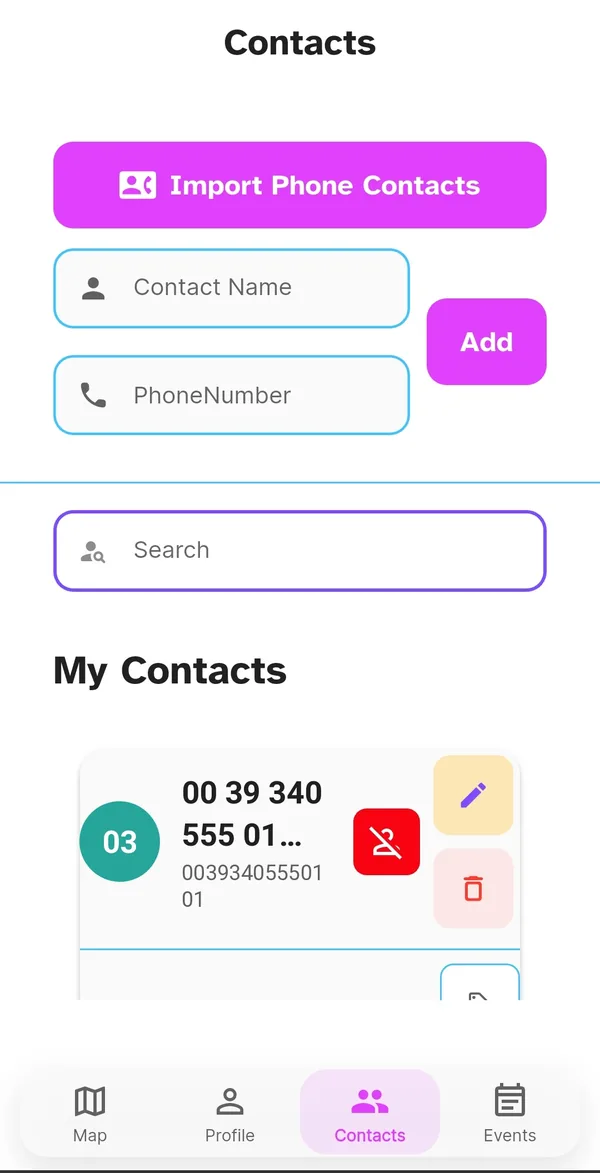
The Contacts page holds the contacts you've imported. Worth repeating, because it matters: they stay on your phone and serve only to make the app work.
For each contact it's your call: keep it, edit it, delete it or block it. And you can add new ones by hand, name and number, without going through an import at all.
Every contact can be filed under one or more tags — your groups: “five-a-side”, “work”, “Rome–Amsterdam”. From there, inviting a whole group is a single tap.
🚫 Blocking and reporting, with peace of mind
Sometimes you'd rather not run into someone again. From the Contacts you block them in two taps, with a confirmation so it isn't done by accident.
The block works both ways: from then on neither of you sees the other's events on the map, in either direction. The other person gets no notification at all. And if they had somehow received an invitation to one of your events, opening it in the app would simply tell them the event isn't available.
If the trouble comes from an event, the same thing is possible from its card: every event — yours or someone else's, past or future — carries a report option for unpleasant content. Reporting automatically blocks whoever created it.
You can also block someone who isn't on orbiTome yet: the block sits waiting against the phone number and takes effect by itself should that person ever sign up. Blocks can be lifted from Contacts whenever you want.
One detail put there on purpose: contacts you remove stay flagged on your phone even after you delete your account, so a fresh import of your address book doesn't quietly bring them back.
The Events page and event cards
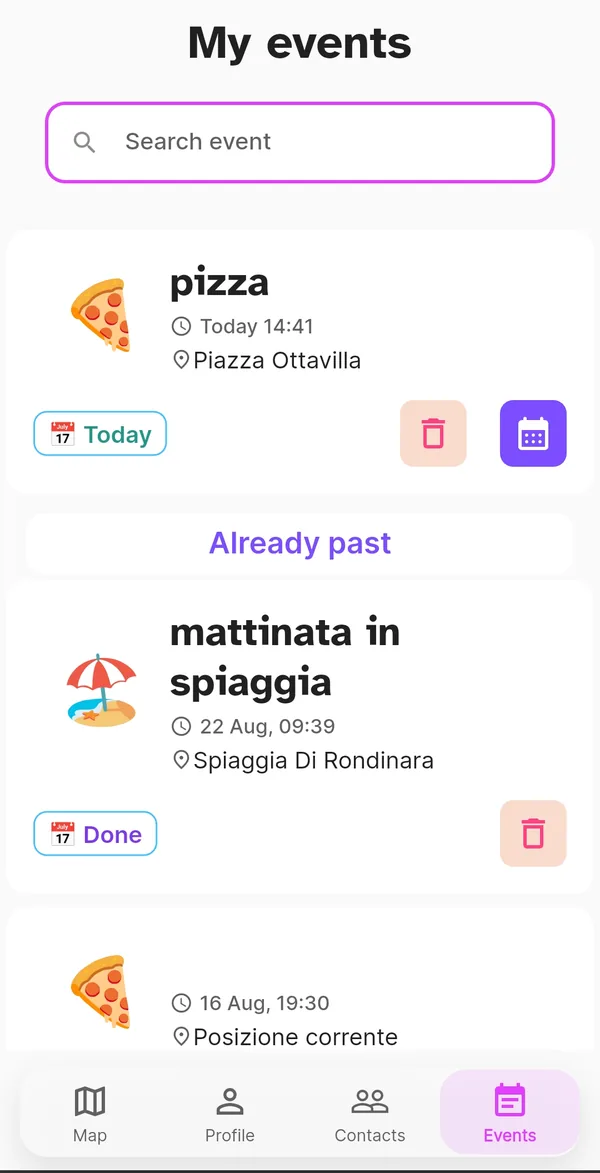
The Events page gathers everything that concerns you and puts it in order: today's and upcoming events first, sorted from the nearest in time to the furthest, then the “Already past” section. Search sits at the top, for finding an event by name.
Upcoming events can be added to your phone's calendar with the dedicated button, so they don't slip your mind.
There is a reminder too: if you granted the notifications permission, the app reminds you in the evening about what's coming up. If you'd rather not get them, notifications can be muted from Profile.
Every event has its own card, and the card changes with what you're looking at. If the event is yours and still ahead, you can add more people. If it's a Wish of yours that has gathered enough interest, the “Create” button turns it into an event that will actually happen. If it's someone else's and has not started yet, you answer “I'm in” or “I'm out”. If it's under way, a single button takes their place: “I'm here” if you are not down as present yet, “I'm off” if you are. If it's past, you see its details and can recreate a similar one in a tap. Invitations and cards also carry the “Navigate to location” button, which opens turn-by-turn directions.
All told, there are at most two answers on screen: before the event “I'm in” or “I'm out”, during the event “I'm here” or “I'm off”. One answer per person per event — changing your mind means picking the other one — and whoever created the event does not see these buttons.
Only one thing to watch: delete a past event and it's gone for good. The app asks for an explicit confirmation, but the action is final.
📷 Event photos
You can add photos to an event's card: a few shots from the evening, so you remember it better when you find it again in your stash.
The photos stay on your phone, along with the rest of your data: they don't end up in an online album.
You can delete them whenever you like, and they go with the event if you remove it from your stash.
My Stash: your memories
Every finished event lands in your personal stash: what, where and when, icon included. A small chronicle of the good things you did together.
Your stash also keeps the answer you gave. At most two of them appear on screen: before the event “I'm in” or “I'm out”, while the event is under way “I'm here” or “I'm off”. And if an invitation slipped past you, there is room to add it.
At the top of the stash there's search: look up a name and you find an evening from months ago without scrolling through everything.
Profile, tags and permissions
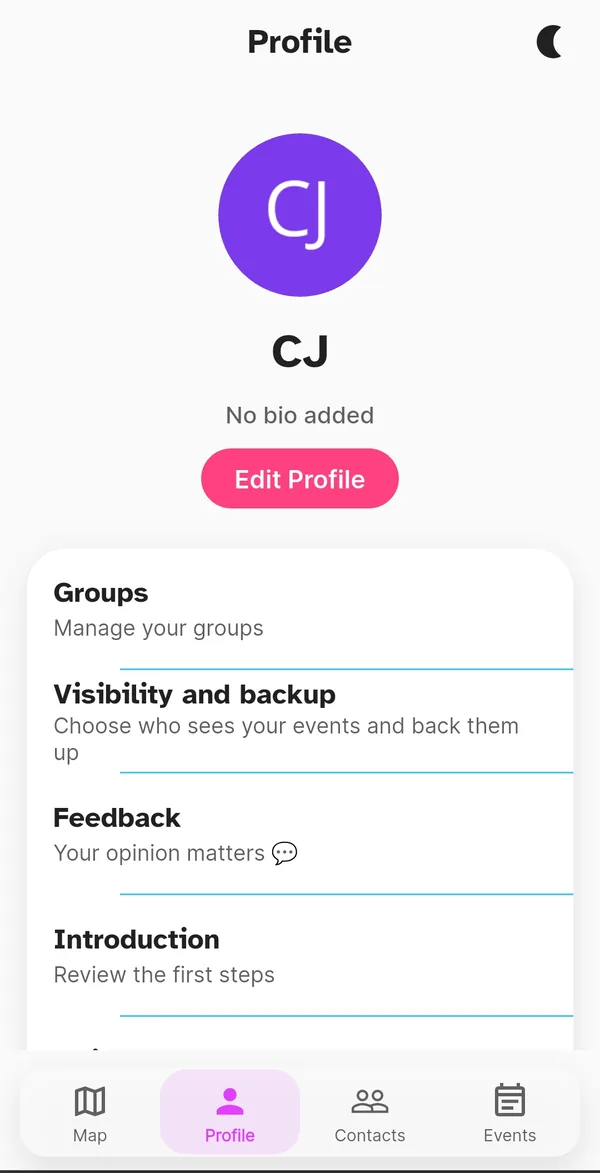
Profile is where you handle the essentials: photo and name, your tags, privacy and invisibility settings, the address book, your memories.
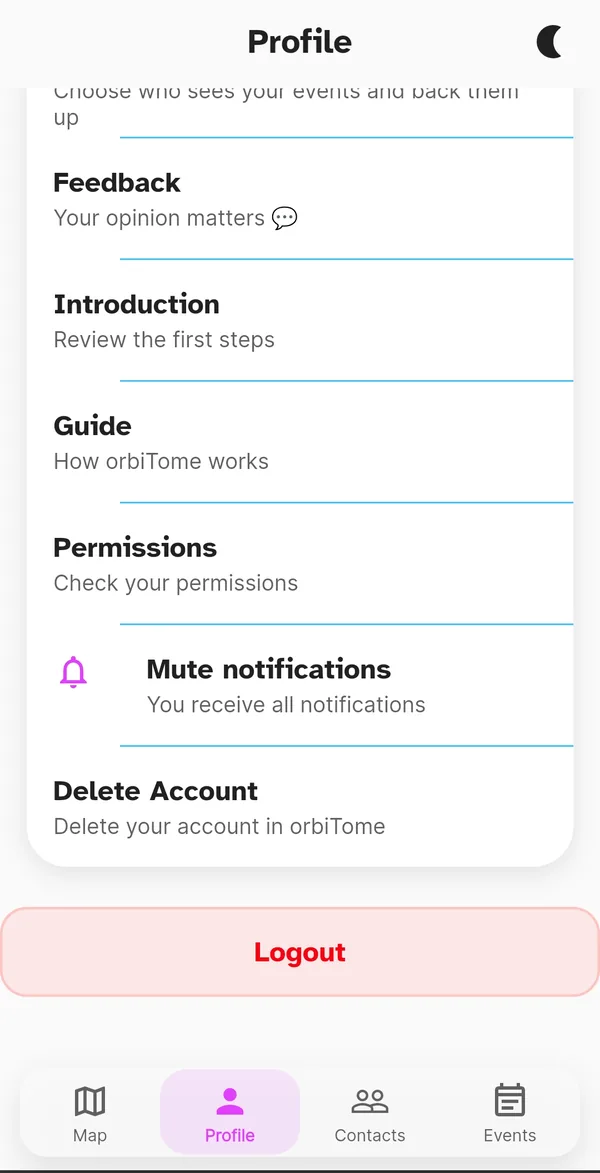
Everything else runs through here too: Introduction to review the first steps, Guide to call up this very page, Feedback to tell us how it's going (thirty seconds is enough), Permissions to check what you've granted, Mute notifications to put them on hold, Logout and — should you ever decide to say goodbye — account deletion.
In the Permissions section every entry is spelled out: contacts, location and notifications, with the reason each is needed and its current state. The crescent-moon icon at the top switches on dark mode.
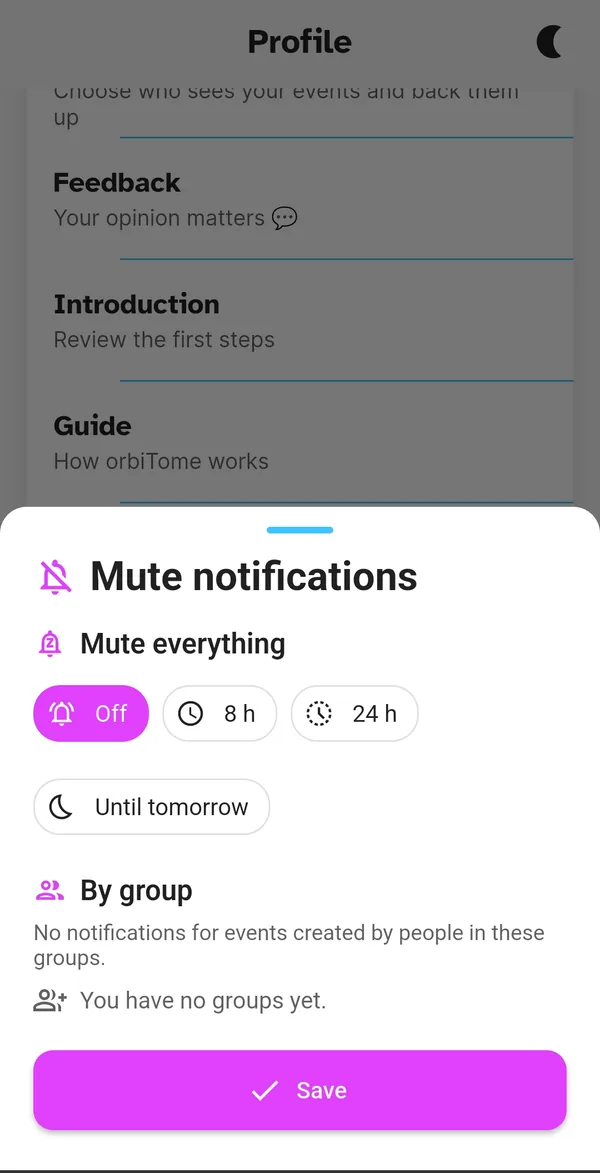
🔕 Mute notifications
From Profile you can pause notifications without uninstalling anything: pick Off, 8 hours, 24 hours or until tomorrow. When the time is up they come back on their own.
The same works for a single group: if one tag is particularly busy, mute that one and keep receiving the rest.
Muting doesn't take you out of any event and doesn't tell anyone: you still see everything in the app, the phone simply stays quiet.
Your data, at home
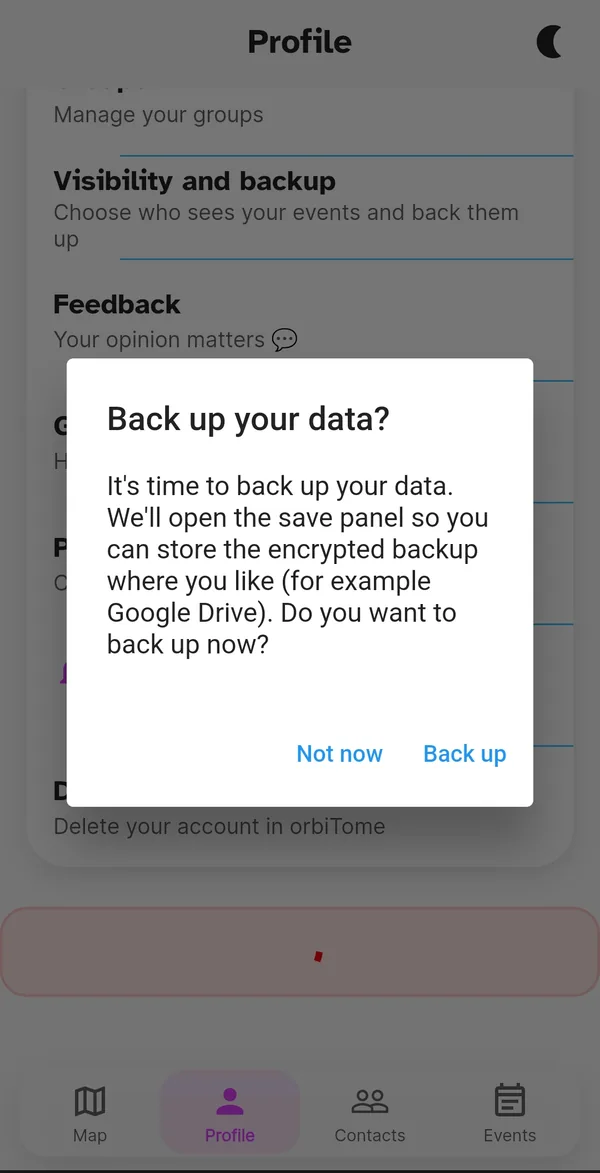
orbiTome runs locally first: events and contacts live in a database on your own device. Whenever you like — and now and then the app reminds you — you create a backup and save it to whichever cloud you prefer, Google Drive for instance.
The backup file is encrypted: reopening it requires your orbiTome account.
Changing phone? “Restore data” puts everything back where it was. And if you decide to leave, account deletion is final and wipes your data — the app asks twice before going ahead.
Frequently asked questions
Is orbiTome free?
Yes, and with no ads. The app is free to download and free to use for creating events, inviting friends and managing your address book.
Why do I have to enter the international dialling code?
Because orbiTome works across several countries and the same number can exist under different codes. Without the code — +44 for the UK, +1 for the US — the verification SMS never leaves.
How long before an event disappears?
It leaves the cloud shortly after it ends; how long it stays visible depends on how you created it (quick chips, “Tonight”, or a date and time from the calendar). Your history stays on your phone. If you are the host and you are on site, the expiry moves back an hour at a time, up to six hours from the start.
Can I pause notifications?
Yes. In Profile, choose “Mute notifications”: Off, 8 hours, 24 hours or until tomorrow. You can mute a single group too, and when the time is up notifications come back on their own.
Who can see my events?
The events you create are visible to your contacts who use orbiTome, or to invitees only if you turn on Invisible event. The map can also show public events published by the orbiTome team: those are visible even to people who don't have the organiser in their address book.
Is my address book uploaded online?
No. Contacts stay on your phone and serve only to recognise which of your friends are already on orbiTome. They are not sent to our servers.
Can I invite people who don't have the app?
Yes. While inviting you generate a link to share by message, email or social apps. Whoever receives it sees all the event details on a web page: to reply and join they need the app, and the link takes them straight to the right store.
What happens when I block someone?
The block is mutual and silent: neither of you sees the other's events any more, and the person receives no notification. You can unblock at any time from Contacts.
Can I recover a past event I deleted?
No. Deleting an event from your stash is permanent — which is why the app asks you to confirm.
Is the backup safe?
The backup file is encrypted: reopening it requires your orbiTome account, even if you store it on a third-party cloud.